Tag: business case study

  • CAFR implements an integrated system for digitizing the coordination of financial auditors in Romania

    CAFR implements an integrated system for digitizing the coordination of financial auditors in Romania

    Context

    CAFR (Romanian Chamber of Financial Auditors), like many other organization, is undergoing a digital transformation. As a result, not only within the profession, but also within the profile associations, changes are unavoidable.

    CAFR has accrued information and experience for over 11 years, using a static database management application with auditors’ reports until the time of implementation. CAFR hopes to provide the over 5,400 members with a comprehensive way to communicate and organize their relationship with the new integrated system.

    The digitized functionalities within the integrated system, developed on the WEBCON BPS platform, are those related to the community management activities:

    • Management of the CAFR relationship with the auditing members, individual or legal persons, full members or trainees;
    • Establishment of payment obligations and information on their settlement;
    • Management of compulsory or optional courses;
    • Control of the inspection activities of the auditing members;
    • Processes related to the Human Resources department of CAFR;
    • Analytical and synthetic reports.

    At present, the system is also linked to the official CAFR auditing members’ site, the e-Learning platform and the financial-accounting application.

    “Our goal was to create integrated business processes that would help and even automate our members’ coordination efforts. Combining digital working practices with workers’ and chamber members’ professional judgment pledges to yield positive results as the most successful way to the future.” – Adrian Popescu, President of CAFR.

    Challenges

    • The need to quick response and flexibly to changes imposed by applicable legislation;
    • Developing a new Financial Intranet based on a business modelling approach with integrated procedures and sub-processes;
    • Increasing agility and lowering costs by giving the IT department true autonomy in the creation of change management processes;
    • Connecting the members-only extranet with the new BPM Intranet platform.

    Solution

    Developing an integrated system in the form of a primary dashboard that unifies many application modules. Each module is made up of procedures, actions, and reports that are organized by the types of tasks that a CAFR department must complete. The transition to the new application went smoothly, and users quickly adopted it.
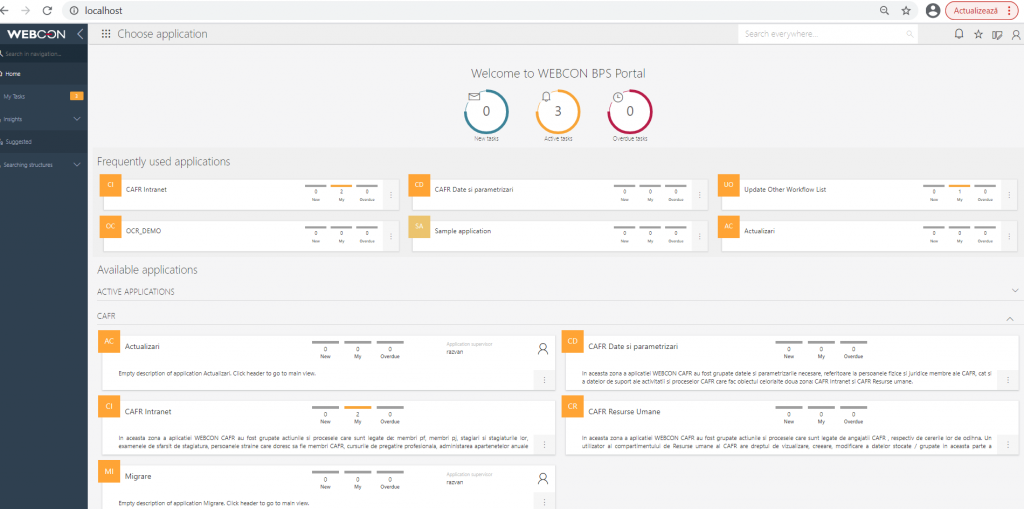
    General dashbord

    Fig 1. General dashboard of the CAFR Intranet application

    The system covers 5 areas that share inter-related stored data with each other: CAFR Data and Parameters, CAFR Intranet, CAFR Human Resources, CAFR Updates and CAFR Migration.

    CAFR Data and Parameters includes:

    • all dictionaries of data related to its members’ historical and current evidence-gathering activities;
    • informational correlations between different areas of activities/processes, links to other application areas – visible among members – and the Chamber’s activities;
    • definition of fees as generators of payment liabilities for each type of member, used in the calculation of fixed or variable fees, and have a direct link to the institution’s financial-accounting application.

    PARAMETERS DASHBOARD

    Fig 2. Parameters dashboard

    CAFR Intranet includes:

    • a suite of parameterized dashboards that group relevant information and actions for each user.
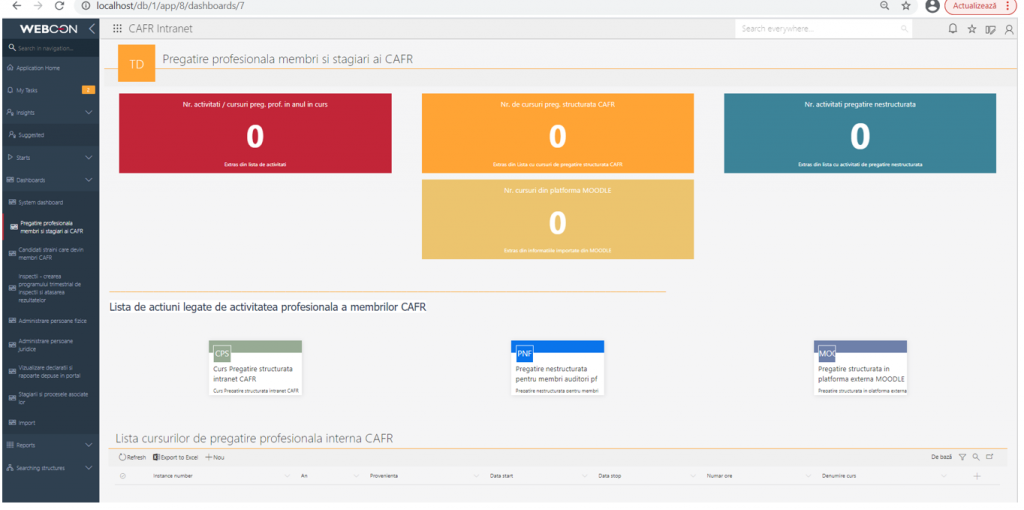
    CAFR Intranet Dashboard

    Fig 3. CAFR Intranet module dashboard – professional preparation of members and trainees

    • the specific operations to each department, membership management workflows, payment obligations, inspections performed or reporting on the activity of members, including courses taken in the e-Learning platform.
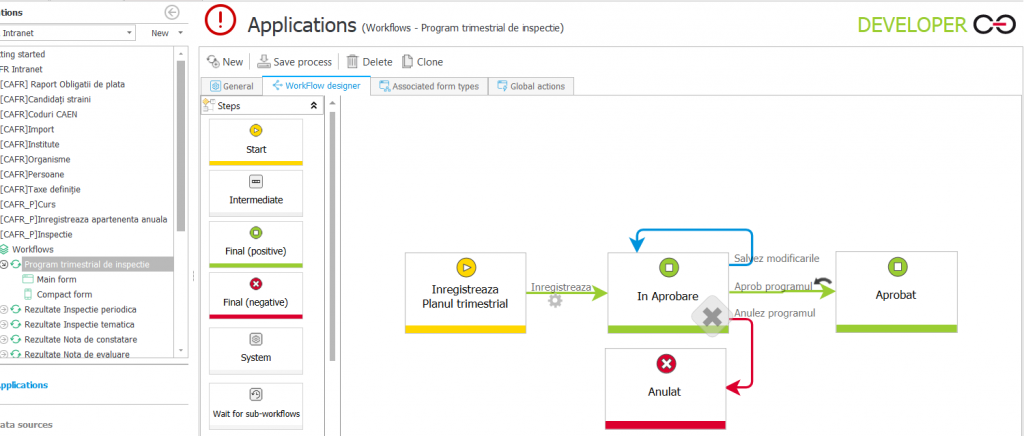
    CAFR SIMPLE PROCESS MODLING

    Fig 4. Example of a simple process for modelling and advance paid by an auditor member

    Complex Process Modeling

    Fig 5. Example of a complex process for modelling

    CAFR Human Resources includes:

    • the vital support for the administration of the contacts of the employees of the institution as well as the process of registration of vacation requests.

    CAFR HR dashboard

    Fig 6. CAFR Human Resources dashboard

    ENCORSA has created a new type of portal for the extranet section, in which members may send activity reports or statements in order to produce a type of annual payment obligation. They are uploaded to the CAFR Intranet, where CAFR workers can view or edit them.

    Results

    Speed of implementation of legal requirements. Required feeds, fields, or reports can be updated in days or hours. Routine changes and the introduction of new workflows are done with CAFR’s internal resources.

    Agility. Possibility of continuous adjustment of workflows in response to legislative changes specific to financial audit; Workflow changes can be sent to users in minutes. CAFR also has the ability to create custom reports.

    Process traceability. Creating comprehensive digital feeds for controlling each compartment’s activity, correlating and displaying tailored information per auditing member, calculating the annual amount due, and using simple links to assist the user in analyzing a member’s activity from multiple perspectives. This tracing is combined with the ability to see a user’s change history.

    Integration of existing systems. All the data necessary to monitor the activity of the members are brought and integrated in the Intranet: the courses carried out in the e-Learning platform, the information on the receipts made or the data on the reports submitted by the members in the External Portal.

    Operational simplification. Unitary management through a single platform of the entire activity of the institution.

    Automatic calculation of fixed or variable taxes. The activity and the changes made in the Intranet part are reflected in the balance of payment / collection obligations that are administered in the financial-accounting application.

    Reports sent to the External Portal are automatically downloaded. Because the reports filed in the portal are taken over and processed immediately, and correlated with the other information in the system, real-time monitoring of the commitments arising from CAFR membership is possible.

    About CAFR

    The mission of the Romanian Chamber of Financial Auditors “CAFR” is to build on a solid foundation, the identity and public recognition of the profession of financial auditor in Romania. Its primary goal is to ensure the profession’s long-term growth and strengthening through the adoption of the Auditing Standards and the Code of Ethical and Professional Conduct, as well as the complete incorporation of the International Standards and the IFAC Code of Ethics. All of this enables financial auditors who are members of CAFR to deliver high-quality services to the general public and, in particular, the business community.

    CAFR has over 5,400 individual members and 1,800 legal entities as direct members, as well as several hundred trainees who are educated and helped in their attempts to join the Chamber.

    Concluding

    The purpose of CAFR’s transformation is to take advantage of technology’s ability to carry out its work more easily, rapidly, reliably, and on a large scale at any moment.

    This system helps to decrease the time spent managing and controlling tasks / procedures to a minimum, in addition to accountability, which is an important feature in any organization.

    The project also yielded tangible results by reducing the time it took to realize, verify and report CAFR members’ activities, as well as eliminating human error.

  • Iridex Group optimizes its activity by digitizing the operational supply chain flow

    Iridex Group optimizes its activity by digitizing the operational supply chain flow

    Progressively, more and more corporations talk about costumer centricity. Therefore, supply chains need to be constructed around their clients. Their leadership is now considered to be a significant strategic stake in the conditions of a dynamic industry, reflecting an essential opportunity for development (the growth of service quality, execution performance and clients’ feedback speed reaction) in terms of service efficiency.

    “Staying anchored in old operating models can cost us considerably; if we do not keep up with the newest technologies we risk losing grounds of reputation let alone in terms of profitability and efficiency of our business”  – Nicolae Tudor, Supply Manager – Iridex Group

    Solution: establishment of a software application dedicated to optimization, streamline and activity monitorization of the supply of products and services.

     flux digital aprovizionare

    Outcomes

    Operational procedure – achieving a complex digital flow throughout the BPMS framework for engender, verification, validation, takeover of the supply production and order distribution activities;

    Mobility – real-time information access regardless location and for the individuals engaged in the flow (freedom of mobility);

    Traceability– the possibility of tracking supply orders in any moment and their progress;

    Operational simplification – managing the status of supply orders, receiving notifications, generating documents and activity reports, all in a single platform;

    The path to the future

    The company wants to impress through digital processes and solid operations in the supply field and recognizes the importance of continuous improvement of the internal business processes’ digitization.

    Thus, this phase of build of digital supply processes prefaces an era that will allow an unparalleled experience for the company’s customers, including ensuring service continuity and tracking the supply rhythm and preserving reasonable pricing by measuring cost flows and analyzing selected suppliers.

    Through this application, the company’s management can consult specific reports at any time, such as the one in the image below.


    About IRIDEX GROUP  

    IRIDEX GROUP  is a company specialized in waste management and provides sanitation services at nation-wide standard. The company is member at IRIDEX companies group and was established in 2008.

    Iridex Group  started its activity around the Constanta county area, providing street sanitation services, waste collection and transportation, operational and management of ecological landfills. They have gradually expanded to several counties, thus diversifying their activities to ensure the integration of waste management. More details on IRIDEX website – https://iridexsalubrizare.ro/

    Challenges

    • operational process of eliminating errors in the supply chain and the improvement of quality of services;
    • objective evaluation of the quality of suppliers’ services;
    • possibility to measure the performance of employees and their load, especially procurement agents;
    • centralization of information about orders in processing, their status and related performance indicators;
    • real-time access to the history of an order (digital library of the acquisition file) that took place inter-departmentally between several operational roles;

    Solution, in detail

    • initialization of supply orders for various categories of products and services in the BackOffice platform (WEBCON BPS) or the mobile application according to internal procedures;
    • generation of the price offers and purchase orders with the possibility of automatic transmission via email to the supplier;
    • the existence of a virtual (digital) library that allows users to view at any time the documents underlying the supply orders (technical details, price offers, purchase orders and so on);
    • separation of responsibilities on flow according to business unit, department and order type (over 50 order analysis nodes);
    • monitoring through reports and indicators such as unfinished orders, expired delivery deadlines or supplier evaluation;
    • application incorporated or email alerts to people involved in the flow according to the status of the supply order.


    Conclusion

    For Iridex this investment in streamlining internal processes by digitizing supply orders ensures that its service or product reaches in time to the applicant, and the continuity and quality of services provided by the company will not be affected. And that it is because the development of digital and analytical capabilities is a priority for the managers.

    Improvements were seen in operational terms, and the advantages of implementation were multiple: easy to store digital documents, accuracy and speed of communication, traceability and visibility of information, the ability to track an order in its all stages.

    The data obtained in this way generates new information and perspectives that will substantiate the following investment decisions, new business models that will provide experiences appreciated by consumers and that can stimulate the innovation so necessary in any business.

  • Deep Serv wins their clients’ trust by using digital workflows

    Deep Serv wins their clients’ trust by using digital workflows

    By focusing on excelling in operations, agility, technical communication and automatic evaluation, Deep Serv transforms the customer experience in building maintenance.


    I believe that digital transformation is a necessary condition to ensure the continuance of a business apart from its founders, and most importantly, to graduate to the next level of operational excellence”, said Marian Spînu, Founder and CEO of Deep Serv.

    Solution: The creation of an automated digital workflow meant to gather complaints and suggestions from clients.


    Results

    Agility — the constant adjustment of the workflows to accommodate the business challenges as they diversify or change;

    Complete optimization — initiating tickets from a mobile app, BackOffice Platform Resolution Flow (WEBCON BPS), triggering new sub-flows to address and fix a persistent problem and managerial reports;

    Clear communication — improving client relationships, transparent procedures and real-time feedback;

    Operational simplificationmanaging ticket solving from a single platform, receiving notifications and service quality assessment dashboards.

    About Deep Serv

    With 20 years of experience, a national coverage and 1,000+ employees, Deep  Serv is a progressive company that can overcome any challenge in the field of professional civil and industrial cleaning (Integrated Facility Services). Currently, the firm works with the largest multinational corporations in Romania.


    The path to the future

    In a business environment subject to uncertainty, Deep Serv’s approach to relying on digitization to gain client trust was a winning decision. The company aims to design an improved customer experience to provide them with an automatic, changeable ticket registration and settlement procedure.

    Challenges

    • Delivering a relevant, easy-to-use and adjustable digital experience by the Internal Support team (which had no IT training);
    • Promoting a culture of data-driven decision-making that translated into increasing the quality of services.


    The right technology, the right people

    In an attempt to determine how, when and where to focus its attention, Deep Serv knew that the interaction with its own clients had to be expressly adapted to the digital environment. The firm was aware that slow and manual procedures, lack of constant communication and quick resolution of feedback received tired clients and decreased profits. Employees had to have information at all times about coordinating client requests — to decide how and when to fix problems.

    Thus, Deep Serv chose the technical solution represented by a digital feed for collecting complaints and suggestions, a flow quickly initiated from an iOS and Android mobile app, based on an access account. The ticket created follows a monitoring path, designed specifically for the needs of employees, through a business process automation platform — WEBCON BPS. With this platform, operational managers can resolve incoming tickets, clients receive real-time notifications about the status of resolution in the mobile app and the company management can view specific reports at any time, such as the one in the image below.


    We chose Encorsa because it provided us with a flexible business process automation technology that has allowed easy adaptation as our needs changed. Moreover, we greatly appreciated the fact that what they promised at the beginning was also achieved, namely that our internal support department could make some changes in the application without specialized IT training”, Marian Spînu– Founder and CEO Deep Serv.


    Reducing complexity, increasing agility

    New visibility into incident developments provides valuable information about customer satisfaction and time-to-time ticket resolution. It also allows new ways to improve services based on real data, collected from feedback.

    For example, Deep Serv can now receive notifications in less than one second, and a client can upload complaints in one minute. At the same time, the quality of materials and consumables improved following the received messages.

    Through a smooth, easily accessible and adaptable flow, Deep Serv employees can comfortably work with user-friendly applications and support the strengthening of the client-business relationship.

    Ensuring a well-received digital experience and collaborative work requires data. Creating a data-driven decision-making culture is obvious in the case of Deep Serv. Now, the average time to resolve a ticket has been significantly reduced — which has resulted in attracting, keeping and regaining clients.


    The solution, in detail

    • Initiating a ticket from the dedicated mobile application, by categories of incidents (quality of services, quality of consumables, etc.) including images taken at the beneficiary’s premises;
    • Ticket resolution flow in the BackOffice platform (WEBCON BPS), according to internal procedures;
    • Seamless real-time in-app communication between business and client, using chatbot functions, permanently mediated by the platform;
    • Giving feedback after each ticket has been resolved on the response time or the quality of the problem resolution;
    • Monitoring by reports and indicators such as: ticket stage, average pickup time, average resolution time, average closing time, average feedback (general or by problem categories);
    • Alerts to open/close a ticket (by email or mobile phone), at several levels of competence and responsibility, depending on the complexity of the client’s organizational structure (e.g. Zonal Operational Manager – Executive Manager – General Manager – Owner).


    For Deep Serv, this automated incident management flow is a solution that will grow and evolve with the business. It will not become obsolete in a few years and it does not require the external intervention of Encorsa specialists.

    As a result of this implementation, the company can already enjoy an improvement in their brand image thanks to the optimization of response times, communication and transparency in the ticketing process.