Author: Catalin Profir

  • CAFR implements an integrated system for digitizing the coordination of financial auditors in Romania

    CAFR implements an integrated system for digitizing the coordination of financial auditors in Romania

    Context

    CAFR (Romanian Chamber of Financial Auditors), like many other organization, is undergoing a digital transformation. As a result, not only within the profession, but also within the profile associations, changes are unavoidable.

    CAFR has accrued information and experience for over 11 years, using a static database management application with auditors’ reports until the time of implementation. CAFR hopes to provide the over 5,400 members with a comprehensive way to communicate and organize their relationship with the new integrated system.

    The digitized functionalities within the integrated system, developed on the WEBCON BPS platform, are those related to the community management activities:

    • Management of the CAFR relationship with the auditing members, individual or legal persons, full members or trainees;
    • Establishment of payment obligations and information on their settlement;
    • Management of compulsory or optional courses;
    • Control of the inspection activities of the auditing members;
    • Processes related to the Human Resources department of CAFR;
    • Analytical and synthetic reports.

    At present, the system is also linked to the official CAFR auditing members’ site, the e-Learning platform and the financial-accounting application.

    “Our goal was to create integrated business processes that would help and even automate our members’ coordination efforts. Combining digital working practices with workers’ and chamber members’ professional judgment pledges to yield positive results as the most successful way to the future.” – Adrian Popescu, President of CAFR.

    Challenges

    • The need to quick response and flexibly to changes imposed by applicable legislation;
    • Developing a new Financial Intranet based on a business modelling approach with integrated procedures and sub-processes;
    • Increasing agility and lowering costs by giving the IT department true autonomy in the creation of change management processes;
    • Connecting the members-only extranet with the new BPM Intranet platform.

    Solution

    Developing an integrated system in the form of a primary dashboard that unifies many application modules. Each module is made up of procedures, actions, and reports that are organized by the types of tasks that a CAFR department must complete. The transition to the new application went smoothly, and users quickly adopted it.
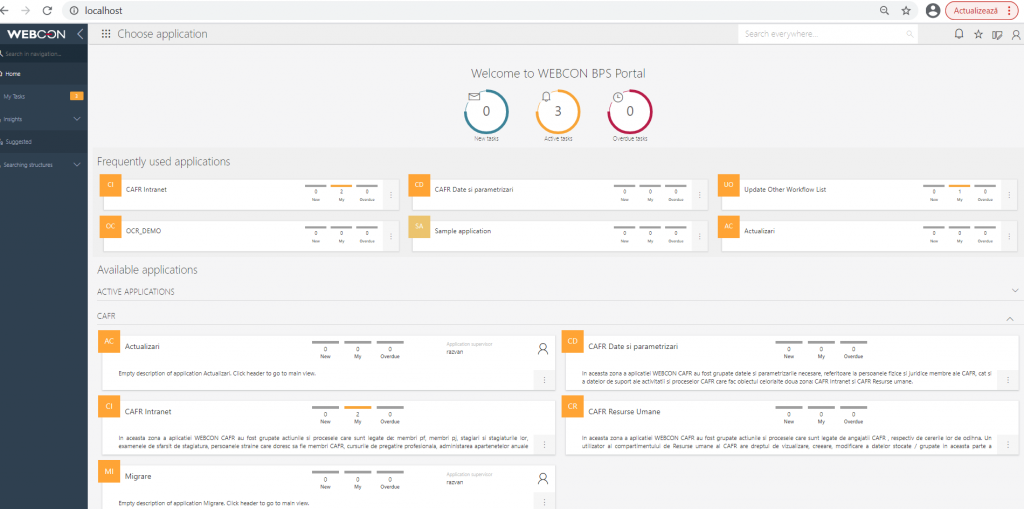
    General dashbord

    Fig 1. General dashboard of the CAFR Intranet application

    The system covers 5 areas that share inter-related stored data with each other: CAFR Data and Parameters, CAFR Intranet, CAFR Human Resources, CAFR Updates and CAFR Migration.

    CAFR Data and Parameters includes:

    • all dictionaries of data related to its members’ historical and current evidence-gathering activities;
    • informational correlations between different areas of activities/processes, links to other application areas – visible among members – and the Chamber’s activities;
    • definition of fees as generators of payment liabilities for each type of member, used in the calculation of fixed or variable fees, and have a direct link to the institution’s financial-accounting application.

    PARAMETERS DASHBOARD

    Fig 2. Parameters dashboard

    CAFR Intranet includes:

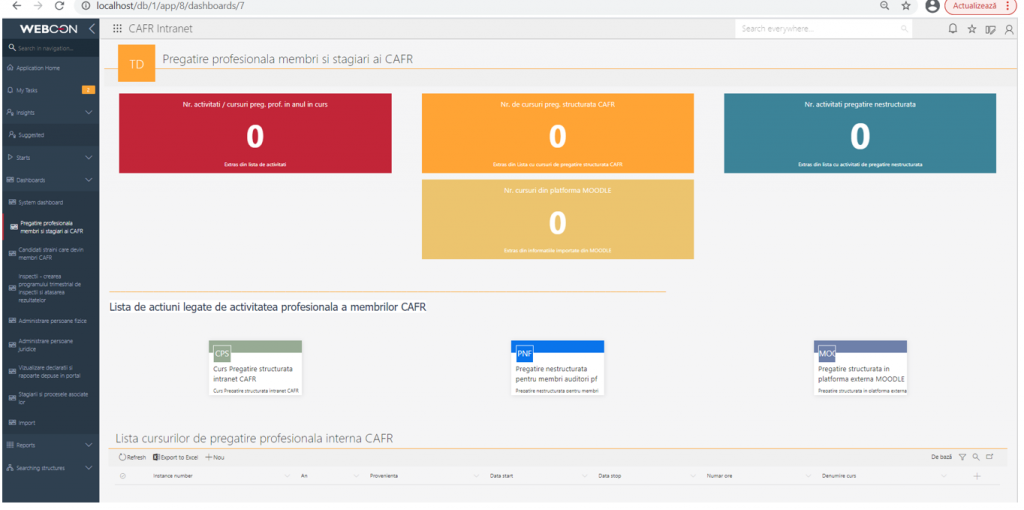
    • a suite of parameterized dashboards that group relevant information and actions for each user.
    CAFR Intranet Dashboard

    Fig 3. CAFR Intranet module dashboard – professional preparation of members and trainees

    • the specific operations to each department, membership management workflows, payment obligations, inspections performed or reporting on the activity of members, including courses taken in the e-Learning platform.
    CAFR SIMPLE PROCESS MODLING

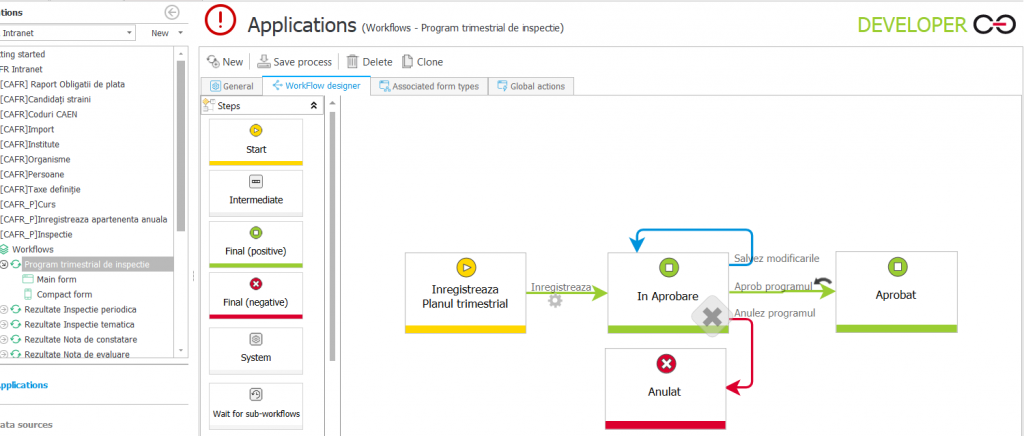
    Fig 4. Example of a simple process for modelling and advance paid by an auditor member

    Complex Process Modeling

    Fig 5. Example of a complex process for modelling

    CAFR Human Resources includes:

    • the vital support for the administration of the contacts of the employees of the institution as well as the process of registration of vacation requests.

    CAFR HR dashboard

    Fig 6. CAFR Human Resources dashboard

    ENCORSA has created a new type of portal for the extranet section, in which members may send activity reports or statements in order to produce a type of annual payment obligation. They are uploaded to the CAFR Intranet, where CAFR workers can view or edit them.

    Results

    Speed of implementation of legal requirements. Required feeds, fields, or reports can be updated in days or hours. Routine changes and the introduction of new workflows are done with CAFR’s internal resources.

    Agility. Possibility of continuous adjustment of workflows in response to legislative changes specific to financial audit; Workflow changes can be sent to users in minutes. CAFR also has the ability to create custom reports.

    Process traceability. Creating comprehensive digital feeds for controlling each compartment’s activity, correlating and displaying tailored information per auditing member, calculating the annual amount due, and using simple links to assist the user in analyzing a member’s activity from multiple perspectives. This tracing is combined with the ability to see a user’s change history.

    Integration of existing systems. All the data necessary to monitor the activity of the members are brought and integrated in the Intranet: the courses carried out in the e-Learning platform, the information on the receipts made or the data on the reports submitted by the members in the External Portal.

    Operational simplification. Unitary management through a single platform of the entire activity of the institution.

    Automatic calculation of fixed or variable taxes. The activity and the changes made in the Intranet part are reflected in the balance of payment / collection obligations that are administered in the financial-accounting application.

    Reports sent to the External Portal are automatically downloaded. Because the reports filed in the portal are taken over and processed immediately, and correlated with the other information in the system, real-time monitoring of the commitments arising from CAFR membership is possible.

    About CAFR

    The mission of the Romanian Chamber of Financial Auditors “CAFR” is to build on a solid foundation, the identity and public recognition of the profession of financial auditor in Romania. Its primary goal is to ensure the profession’s long-term growth and strengthening through the adoption of the Auditing Standards and the Code of Ethical and Professional Conduct, as well as the complete incorporation of the International Standards and the IFAC Code of Ethics. All of this enables financial auditors who are members of CAFR to deliver high-quality services to the general public and, in particular, the business community.

    CAFR has over 5,400 individual members and 1,800 legal entities as direct members, as well as several hundred trainees who are educated and helped in their attempts to join the Chamber.

    Concluding

    The purpose of CAFR’s transformation is to take advantage of technology’s ability to carry out its work more easily, rapidly, reliably, and on a large scale at any moment.

    This system helps to decrease the time spent managing and controlling tasks / procedures to a minimum, in addition to accountability, which is an important feature in any organization.

    The project also yielded tangible results by reducing the time it took to realize, verify and report CAFR members’ activities, as well as eliminating human error.

  • INSURANCE Claims Processing Automation

    INSURANCE Claims Processing Automation

    Context 

    The claims procedure is one of the essential operational processes for an insurance company. The process begins with the client notification about the damage and continues with steps as such aligning with checking the beneficiary and insurance policy or multiple policies, validating the type of event coverage, medical validation, possible fraud detection, going through the payment file approval process, generating payment files and closing files. Throughout this process, the insured person and various actors must be notified according to the status of the file and the related information accumulated as a result of the file workflow from one actor to another. In addition, the process is not meant to be linear but branched according to the diverse parameters of the file (policy type, event type, payment amount, and other variables). Last but not least, the platform must integrate the core business systems, the DMS, banking systems, and accounting applications. 

    Challenge  

    BCR Insurance was using for its claims processes an IT architecture combining the individual email reception with manual (human) processing and verification of requests in the core systems, manual generation of payment files and those needed for opening bank accounts, and email transfer of information to third parties (e.g., doctors). As a result of the clients’ number growth, so did the challenges that occurred: 

    • Long closing times (of files) – manual checking of the core system policies, email communication between the actors of the process, manual generation of the files, and the complexity of the process arose an increase of the processing time of the requests, especially in the case when the client was not submitting all documents required from the beginning; 
    • Operational errors – as the increase in demand of processes is part of the daily operations, so their manual interpretation and their transfer of documents via email, the processing margin error and implicitly the number of re-submitted files within the workflow after verification; 
    • Poor client communication – before the implementation, the client was informed only when exceptions were to be discussed, not having a clear status of the file or the steps tracking within the process 
    • Reporting and monitoring difficulties – every file’s timeline and the aggregated and complex reports given within the process were hard to obtain and need manual processing. Moreover, a real-time situation, whether aggregated or specific (per file), was difficult to obtain. 


    The chosen solution  

    The chosen solution was Encorsa’s custom application implemented by two low-code technologies: a BPM platform incorporated within the internal workflow, supplementing the RPA robots, operating within the core system’s data. The communication within the core systems and the third parties’ systems is to be done throughout the API or, in the case of legacy systems, the RPA robots. The email messages transmitted to clients are taken over automatically by the system, and its claims file is initiated and allocated by the consultant. 

    The system automatically communicates with the core system, thus permitting the validation and the check-up of the policies, the generation of bank files, and the payment papers. The client is notified as soon as the status of the file is changed. In addition, the approval and audit mechanism are incorporated within the platform aiming at a coherent and fast unroll of the claim validation process. 

    Benefits of the implemented process automation platform  

    As a result to the implementation of the automated claim process platform, there were obtained the following benefits: 

    • Simplified operation and its speed 
    • The BCR Insurance operator is not following a series of software applications, instead is having at hand a single interface visualizing and operating all information needed in the claim; 
    • Calculation of sums are automated by the system depending of the parameters; 
    • The doctors are directly involved in the completion of necessary info; 
    • File generation are automatically processed for third parties; 
    • Real-time feedback  
    • The client is notified automatically depending on the actual step (status) of the policy; 
    • Predictability and control  
    • The advanced traceability of the file is possible with the real-time check-up of the actual status (workflow step), operation linking the time and user involved; 
    • Digital File storage in Repository is automated. 


    About BCR Insurance  

    BCR Life Insurance is an enterprise member of Insurance Vienna Group, one of the most prominent international insurance groups of the central and eastern EU. Established in 2005 as a BCR subsidiary, the company began its activity in 2006. In the same year, ERSTE Group becomes the lead shareholder of BCR, thus BCR Life Insurance ranking as a direct result in the top 10, more precisely the 8th place of Romania’s life insurance company. In 2007, the enterprise was also authorized as the administrator of the optional pension, further launching their first founding and becoming the industry leader. In September 2008, Vienna Insurance Group (VIG) became the prime shareholder of the company, thus the enterprise gaining a new logo. Starting with 2009, the company becomes the market leader in life insurance and occupies the second position in this industry. Client orientation, constant adaption on the market, innovation, development of distribution channels, and the attention to employees gained the company the title of “Company of the Year” four times in a row. 

    Conclusion 

    Using an agile methodology, the BCR Insurance team, in collaboration with Encorsa, succeeded in developing a custom automated platform of claim processes adapted to the client’s needs in only 6 months. In addition, the platform enabled the acceleration of the files solving process, error reduction, increased operational efficiency, real-time feedback for both clients and management, and the integration of the company’s core systems. Moreover, soon, every adaption of business workflows can be done faster, allowing the change to be done more agilely regarding the challenges given by the external business environment. 

  • Quasar Comex gains performance and business continuity by automating internal processes

    Quasar Comex gains performance and business continuity by automating internal processes

    An advanced space where humans and RPA robots cooperate for unitary activity between existing applications, streamlining processes and and particularly decreasing expenses.

    “I believe that digitization and automation are the key solutions for adapting to the current reality. We chose to invest in technological applications meant to increase the customer experience, to help operational productivity and maintain existing staff “, says Laurențiu Țigăeru Roșca, Founder and CEO of QUASAR COMEX.

    Solution: Create a computerized advanced stream for taking requests, charging, producing AWBs and announcing as a Digital Employee devoted to E-Commerce.

    E-commerce Automation Workflow

    Results

    Activity procedure – establishing an advanced digital stream for dealing with the movement of taking and conveying orders, deftly adjusted on the BackOffice stage (WEBCON BPS); this stream naturally coordinates programming robots for computerizing microflows, for example, charging or AWB age;

    Agility – continuous adjustment of workflows as business challenges diversify or change, using WEBCON BPS’ ability to editing flows in real time – INSTANT CHANGE;

    Optimization of human asset stacking – via computerizing exercises with the assistance of programming robots, HR being diminished of monotonous undertakings, for example, assuming control over request information, invoicing, dropping requests on totally related stages, deciphering AWBs for Bulgaria or Hungary, and so on;

    Operational simplification – unit management of the entire activity from a single platform, thus creating a digital space where individuals can intercede (eg dropping a request) on the action attempted by robots.

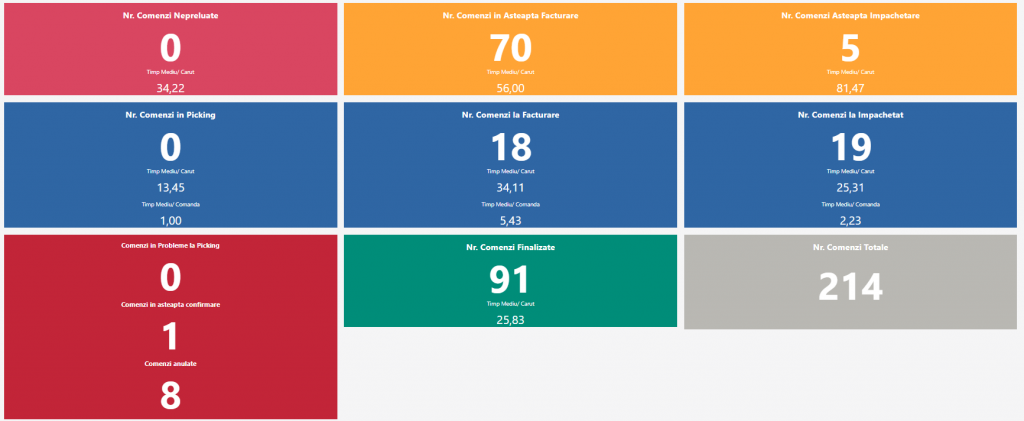
    Below you will be able to view a control panel with activity indicators (KPIs) measured in real time.

    Encorsa Dashboard

    About QUASAR

    For over 27 years, Quasar Comex SRL does only exchange exercises and the experience and presence on 2 unfamiliar business sectors (Bulgaria, Hungary) shows consistency and creates trust the two clients and colleagues. Since 2015, it likewise creates online activities, and today this vertical is the principle hub of advancement of the organization. He additionally moved toward different deals channels, specifically Marketplaces: eMAG Romania, Cel, Elefant, Kalapod, TeamDeals, Allshops and MiniPrix.

    Constant optimization of the business through processes automation

    Without an arrangement of front and back-office business measures and without a coordinated way to deal with furnishing individuals with key data continuously, the difficulties of the present business climate will be hard to defeat sooner rather than later. the years to come. Hence, the organization expects to execute a back-office application that supports and permits such an exertion.

    Quasar Comex has figured out how to expand its efficiency at any rate multiple times by executing mechanical robotized measures in the current movement of overseeing orders from online deals. In spite of the fact that Quasar Comex deals nearly significantly increased in 2020, the production of advanced work processes has figured out how to oversee exercises without extra staffing, ideally and without mistakes.

    Challenges

    • Managing sales growth, without hiring addition human resources;
    • Proceduring the action to wipe out mistakes and improve the nature of administration conveyance in the E-Commerce business;
    • End of dull errands for individuals with the goal that they possess energy for complex investigates important to smooth out the online deals business (top beneficial items, recognizable proof of poisonous stocks, and so on).

    Digital Employee in E-commerce, detailed solution

    • Creating an advanced work process through the Low-Code Business Process Management stage – WEBCON BPS, subsequently binding together the progression of data between existing programming segments – ERP, WMS, Marketplaces, own online store, dispatch stages (Sameday, DPD)
    • Automatic monitoring of the entire flow and generation of real-time indicators such as:
      • Average pick-up time
      • Pending orders on picking
      • Pending orders in invoicing
      • Average order pick-up ime
      • Canceled orders
      • Pending packaging orders
      • Average order packing time
      • Number of completion orders
      • Average completion time
      • Number of total orders;
    • Implementation of the mobile application for pickers (as a part of the WEBCON BPS platform) for taking over packing orders by pickers but also notifying them of changes made to orders;
    • Automation of repetitive tasks such as billing, printing, AWB generation, document reprinting, was done with RPA software robots, coordinated through the WEBCON BPS platform;
    • Creating measures through which individuals can intervene in decision making (for instance changing a request or dropping it), after whitch the flow will be proceeded automatically, being taken over by a software robot under the coordonation of WEBCON BPM;
    • Setting up specially appointed reports to gauge measure proficiency, task discernibility and continuous choice announcing (call-to-arrange forthcoming rundown).

    Conclusion

    For Quasar Comex, the platform called Digital Employee in E-Commerce is the solution that provided them with robotic tools in order to generate a fast and error-free internal flow, tracking human intervention and reducing costs.

    Because of this implementation, there is a reasonable expansion in efficiency and deals and the stream from taking requests, invoicing, creating AWBs and announcing goes on autopilot. Digitization is the future and Quasar Comex has understood that its business can be improved and smoothed out with the assistance of mechanical arrangements fitting to the current action and developing with the adjustments in the business environment.

  • Deep Serv wins their clients’ trust by using digital workflows

    Deep Serv wins their clients’ trust by using digital workflows

    By focusing on excelling in operations, agility, technical communication and automatic evaluation, Deep Serv transforms the customer experience in building maintenance.


    I believe that digital transformation is a necessary condition to ensure the continuance of a business apart from its founders, and most importantly, to graduate to the next level of operational excellence”, said Marian Spînu, Founder and CEO of Deep Serv.

    Solution: The creation of an automated digital workflow meant to gather complaints and suggestions from clients.


    Results

    Agility — the constant adjustment of the workflows to accommodate the business challenges as they diversify or change;

    Complete optimization — initiating tickets from a mobile app, BackOffice Platform Resolution Flow (WEBCON BPS), triggering new sub-flows to address and fix a persistent problem and managerial reports;

    Clear communication — improving client relationships, transparent procedures and real-time feedback;

    Operational simplificationmanaging ticket solving from a single platform, receiving notifications and service quality assessment dashboards.

    About Deep Serv

    With 20 years of experience, a national coverage and 1,000+ employees, Deep  Serv is a progressive company that can overcome any challenge in the field of professional civil and industrial cleaning (Integrated Facility Services). Currently, the firm works with the largest multinational corporations in Romania.


    The path to the future

    In a business environment subject to uncertainty, Deep Serv’s approach to relying on digitization to gain client trust was a winning decision. The company aims to design an improved customer experience to provide them with an automatic, changeable ticket registration and settlement procedure.

    Challenges

    • Delivering a relevant, easy-to-use and adjustable digital experience by the Internal Support team (which had no IT training);
    • Promoting a culture of data-driven decision-making that translated into increasing the quality of services.


    The right technology, the right people

    In an attempt to determine how, when and where to focus its attention, Deep Serv knew that the interaction with its own clients had to be expressly adapted to the digital environment. The firm was aware that slow and manual procedures, lack of constant communication and quick resolution of feedback received tired clients and decreased profits. Employees had to have information at all times about coordinating client requests — to decide how and when to fix problems.

    Thus, Deep Serv chose the technical solution represented by a digital feed for collecting complaints and suggestions, a flow quickly initiated from an iOS and Android mobile app, based on an access account. The ticket created follows a monitoring path, designed specifically for the needs of employees, through a business process automation platform — WEBCON BPS. With this platform, operational managers can resolve incoming tickets, clients receive real-time notifications about the status of resolution in the mobile app and the company management can view specific reports at any time, such as the one in the image below.


    We chose Encorsa because it provided us with a flexible business process automation technology that has allowed easy adaptation as our needs changed. Moreover, we greatly appreciated the fact that what they promised at the beginning was also achieved, namely that our internal support department could make some changes in the application without specialized IT training”, Marian Spînu– Founder and CEO Deep Serv.


    Reducing complexity, increasing agility

    New visibility into incident developments provides valuable information about customer satisfaction and time-to-time ticket resolution. It also allows new ways to improve services based on real data, collected from feedback.

    For example, Deep Serv can now receive notifications in less than one second, and a client can upload complaints in one minute. At the same time, the quality of materials and consumables improved following the received messages.

    Through a smooth, easily accessible and adaptable flow, Deep Serv employees can comfortably work with user-friendly applications and support the strengthening of the client-business relationship.

    Ensuring a well-received digital experience and collaborative work requires data. Creating a data-driven decision-making culture is obvious in the case of Deep Serv. Now, the average time to resolve a ticket has been significantly reduced — which has resulted in attracting, keeping and regaining clients.


    The solution, in detail

    • Initiating a ticket from the dedicated mobile application, by categories of incidents (quality of services, quality of consumables, etc.) including images taken at the beneficiary’s premises;
    • Ticket resolution flow in the BackOffice platform (WEBCON BPS), according to internal procedures;
    • Seamless real-time in-app communication between business and client, using chatbot functions, permanently mediated by the platform;
    • Giving feedback after each ticket has been resolved on the response time or the quality of the problem resolution;
    • Monitoring by reports and indicators such as: ticket stage, average pickup time, average resolution time, average closing time, average feedback (general or by problem categories);
    • Alerts to open/close a ticket (by email or mobile phone), at several levels of competence and responsibility, depending on the complexity of the client’s organizational structure (e.g. Zonal Operational Manager – Executive Manager – General Manager – Owner).


    For Deep Serv, this automated incident management flow is a solution that will grow and evolve with the business. It will not become obsolete in a few years and it does not require the external intervention of Encorsa specialists.

    As a result of this implementation, the company can already enjoy an improvement in their brand image thanks to the optimization of response times, communication and transparency in the ticketing process.